In the modeling and simulation, there are two main approaches in simulating mass, heat, and momentum transport, continuum and discrete approaches . In continuum approach, the ordinary and partial differential equations are solved by applying conservation of mass, heat, and momentum. Solving partial differential equation by converting the governing differential equations into a system of algebraic equations by applying the given boundary and initial conditions. Converting the differential equations into the system of algebraic equations can be done by using Finite volume, difference, and element. Discrediting the domain into volume (Finite Volume) ,grids (Finite Difference), or elements(Finite Element) depending on the method of solution. Each domain of volume, element, or grid has a collection of particles. The scale is macroscopic.
The second approach is the discrete approach. This type of approach can be considered made of small particles such as atom, molecules which collide each other. This scale is known as microscopic scale. Ludwig Eduard Boltzmann (1844-1906), the Austrian physicist, had the greatest achievement in the development of statistical mechanics. This approach has been used to predict macroscopic properties of matter such as the viscosity, thermal conductivity, and diffusion coefficient from the microscopic properties of atoms and molecules [1-3]. The probability of finding particles within certain range of velocities at a certain range of locations replaces tagging each particle as in molecular dynamic simulation. Historically, the lattice Boltzmann method originated from the lattice-gas cellular automata method (LGCA)[4], The LBGK which is known as the lattice Bhatnagar-Gross-Krook method has been developed rapidly and applied for many studies. The nonlinear term in the lattice Boltzmann approximated by BGK to become linear term, and this term is known as the collision term in the lattice BGK governing equation. The main idea of LBM is to bridge the gap between micro-scale and macro-scale by not considering individual behavior of particles alone but behavior of a collection of particles as a unit. The property of particle is represented by a distribution function. The distribution function acts as a representative for collection of particles. This scale is unknown as mesoscopic scale. The terminology of the kinetic theory is the heart of lattice Boltzmann equation. Hence, discrete solver should identify the inert-particle force. Using discrete approach needs to specify location and velocity of each particle. At microscopic level, there is no definition of temperature, pressure, and thermo-physical properties such as viscosity (υ), thermal diffusivity (α), and heat capacity (<!--[if !msEquation]-->

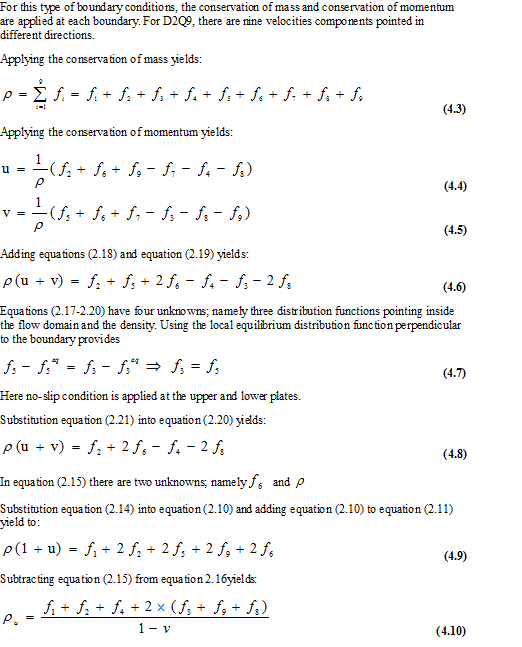
Types of LBM Boundray Conditions:

LBM Governing Equation


The governing equation of the lattice Boltzmann has two terms:
Collision term which can be defined as:

Streaming term which can be defined as:

Neumann Boundary Conditions